




PRP and PRF both start as a small tube of your own blood. The split happens in the lab step: one is spun with an anticoagulant and stays liquid, the other is spun without one and starts to set into a soft fibrin gel. That single change shapes how quickly each one releases its growth factors, and it explains why the research on them looks so different.
PRP vs PRF verdict by treatment goal
On the published evidence, the PRP vs PRF question has a different answer for each goal. PRP has far more trials behind it for thinning hair and for pairing with microneedling on scars and texture. PRF has a smaller, newer record, with early head-to-head studies that lean its way for hair counts and for steadier under-eye color.
- Thinning hair: PRP has the deeper research base. One recent head-to-head trial favored PRF, but it is a single study.
- Skin texture and acne scars: PRP, usually alongside microneedling, is the combination most studied.
- Under-eye darkness and fine lines: both improved in a split-face trial, with PRF giving a steadier drop in pigment and redness.
- Hollow under eyes: both eased mild hollowness in one trial, but neither corrected severe hollows.
4Ever Young centers offer PRP hair treatment at 4Ever Young, along with PRP facials and under-eye PRP. PRF is not on the 4Ever Young treatment menu, so ask your local center whether it offers PRF before planning around it.
PRF vs PRP at a glance
If you have read PRF vs PRP pages from clinics, most of them describe preparation and leave out the evidence. This table sets the two side by side using the lab studies, clinical trials and regulatory reviews in the Sources list, checked October 21, 2026.
| Category | PRP | PRF |
|---|---|---|
| What it is | Concentrated platelets in liquid plasma | Platelets and white blood cells held in a fibrin network |
| Anticoagulant | Yes | No |
| Spin | One or two spins | One spin, no delay |
| Growth factor release in the lab | ✓ Highest in the first hour | ✓ Steady for up to 10 days |
| Hair research | ✓ Many trials and meta-analyses | A handful of newer, smaller trials |
| Studied with microneedling for scars | ✓ Yes, split-face trial | Little published data |
| Under-eye split-face trial | Improved, with pigment rising at month 3 first | ✓ Improved, with a steadier fall in pigment |
| FDA status for cosmetic use | Not FDA approved, used off-label | Not FDA approved, used off-label |
| Offered at 4Ever Young | ✓ Yes, for hair, skin and under eyes | Not listed, ask your center |
Read the release row as lab chemistry, not a clinical result. It comes from 18 blood samples from six donors, measured in a dish rather than in skin.
How PRP & PRF compare side by side
The difference between PRP and PRF starts with a choice in the lab about clotting. Everything else, from texture in the syringe to the pace of growth factor release, follows from it.
How each platelet concentrate is prepared
For PRP, blood is drawn into a tube containing an anticoagulant, then spun so the heavy red cells settle and the platelet-rich plasma can be drawn off. Systems differ in speed, in whether they use one spin or two, and in how many white blood cells they keep. Researchers sort the products into groups for exactly that reason, because two vials labeled PRP can be quite different products.
Platelet rich fibrin skips the anticoagulant. The blood is spun right away, before it clots, and the fibrin that forms traps platelets and white blood cells together. The French researchers who introduced it called it a second-generation platelet concentrate in 2006, and dentistry is still where most PRF research lives. The encyclopedia entry on PRF preparation & clinical uses lays out the standard protocol.
For injections under the skin, providers use a liquid version drawn off before it sets, usually called injectable PRF or i-PRF.
Growth factor release over time
Platelets carry growth factors such as PDGF, TGF-beta and VEGF, the proteins that signal tissue to repair. A 2016 study from the University of Bern compared how fast PRP and two kinds of PRF released them.
PRP released significantly more in the first 15 to 60 minutes. Over 10 days, the fibrin versions kept releasing at a steady rate, and the advanced PRF protocol delivered the largest total. The authors framed it simply: PRP for fast delivery, PRF for slower, longer release.
Whether a slower release changes what you see in the mirror is still an open question in skin and scalp trials.
PRF vs PRP for face rejuvenation
For the face, PRP has the stronger record, mostly as a partner to microneedling. In a split-face trial of 50 patients aged 17 to 32 with atrophic acne scars, the side treated with microneedling plus PRP improved by 62.2 percent on a standard scar scale after three monthly sessions, against 45.8 percent on the side treated with microneedling and distilled water.
Direct PRF vs PRP for face comparisons outside the eye area are scarce. The fairest summary today: PRP is the better documented choice for texture and scars, and PRF is a plausible alternative still waiting for larger trials.
PRF vs PRP under eyes
Under-eye skin is where the two have been tested against each other most carefully. In a randomized split-face trial published in the Journal of Cosmetic Dermatology in 2026, 24 adults received PRF under eyes on one side and PRP on the other, three sessions each, with follow-up to month 7.
Both sides improved in hyperpigmentation, fine wrinkles and mild hollowness, with no significant difference between them on most measures. Melanin and redness fell steadily on the PRF side from month 3, while on the PRP side they rose at month 3 before declining.
So on PRF vs PRP under eyes, PRF looks slightly steadier for dark circles, and the two look similar for fine lines.
An earlier, smaller study of PRP under eyes treated 10 adults in one session and found better color evenness at three months, but no significant change in melanin, hydration or wrinkle measurements. Neither treatment corrected severe hollowness in the 2026 trial, which is where filler usually comes in.
PRP vs PRF for hair
Hair is where PRP has the most data. A 2024 meta-analysis of randomized trials found PRP added about 27.6 hairs per square centimeter over placebo, while also calling the evidence low quality because the studies varied widely in method and showed publication bias. The same review found no significant change in hair thickness.
Head-to-head data on PRP vs PRF for hair is newer. In a 2026 randomized trial of 74 women with female pattern hair loss, four sessions of injectable PRF raised hair counts by about 26.5 percent at 24 weeks against 14.5 percent for PRP, with the fewest side effects in the PRF group. It is one trial in one group of patients, so treat it as an early signal.
Not sure which platelet treatment fits your goal?
A 4Ever Young provider looks at your skin, scalp and history first, then explains whether PRP, another treatment or a combination makes sense.
Book a ConsultationWho should choose PRP or PRF
PRP is the practical choice for most people comparing the two, partly because it has more evidence and partly because it is what 4Ever Young centers offer.
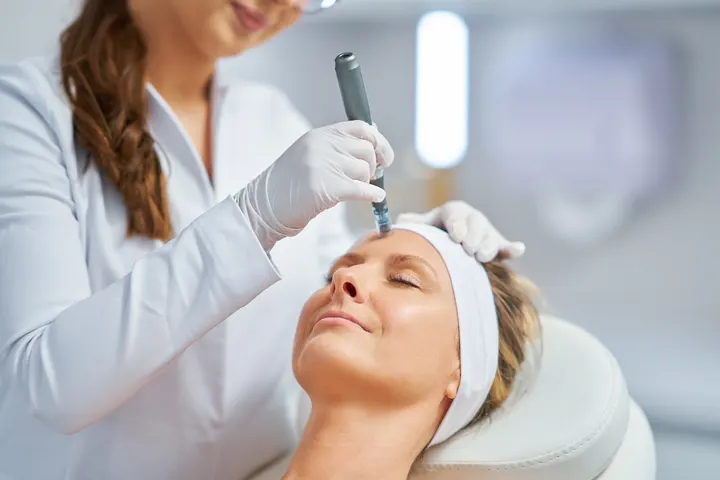
- You want a PRP hair treatment for early pattern thinning and would like it inside a broader plan. 4Ever Young’s Hair loss treatment options can combine PRP with microneedling, medications such as minoxidil and finasteride, and hormone care.
- Acne scars, enlarged pores or dull texture are the concern. Microneedling with PRP is the combination behind the split-face scar results above.
- You want a light refresh for under-eye darkness and crepey skin, with modest expectations.
PRF is worth asking about if a provider near you offers it and you are treating under-eye pigment, or if you have read the early hair trials and want the newer option. Expect fewer published results to judge it by.
Neither fits deep tear troughs. When the hollow comes from lost volume, a Dermal filler for under eyes lifts it in a way platelet injections do not.
Both treatments start with a screening visit. Tell your provider about any blood disorder, blood thinner, skin infection or pregnancy, because each one changes the plan.
Bottom line on platelet therapy
Choose by goal. PRP is the better studied option for hair and for scars treated with microneedling. PRF looks promising for under-eye color and in early hair trials, but it rests on far less research.
Both are made from your own blood, both are used off-label, and in both cases the provider’s preparation method and technique shape the result. A 4Ever Young consultation starts there, and a 4Ever Young membership takes 10 to 20 percent off most services if PRP becomes a series.
PRP vs PRF questions patients ask
01Is PRF Better Than PRP?
Is PRF better than PRP? Not across the board. PRF releases growth factors more slowly and steadily, and two recent trials favored it for under-eye pigment and for hair counts in women. PRP has far more published research for hair loss and for microneedling on acne scars. 4Ever Young centers offer PRP, so ask your local center whether PRF is available.
02How Many PRP Sessions Do You Need?
Most studies used three or four sessions spaced about four weeks apart: three monthly sessions in the 50-patient acne scar trial and four in the 2026 hair trial. The under-eye trial authors suggested repeat sessions every 3 to 4 months to maintain results. Your provider sets the plan after seeing how your skin or scalp responds.
03Does PRP Under Eyes Hurt?
PRP under eyes is injected into thin skin, so most people feel pressure and a brief sting, and providers often apply numbing cream first. Mild swelling or a small bruise can last a few days. In the 2026 split-face trial, both PRP and PRF were tolerated over three sessions with no major adverse effects reported.
Weighing PRP for your hair or skin? Book a consultation at a center near you →
Featured From the Blog
 Featured · Skin
Microneedling for Acne Scars: How It Helps and What to Expect
How microneedling triggers collagen and elastin to remodel indented acne scars, which scar types respond best and what a series of sessions looks like.
By Claritza Valle · Jun 6, 2025Read article →

Sources
- Kobayashi E et al., Clinical Oral Investigations, 2016 – Comparative release of growth factors from PRP, PRF and advanced PRF over 10 days
- Dohan DM, Choukroun J et al., Oral Surgery, Oral Medicine, Oral Pathology, 2006 – Platelet-rich fibrin as a second-generation platelet concentrate
- Beitzel K et al., Journal of Knee Surgery, 2015 – FDA stance on PRP: 510(k) cleared preparation systems, off-label office injection
- Asif M et al., Journal of Cosmetic Dermatology, 2016 – Split-face trial of microneedling with PRP vs distilled water for atrophic acne scars
- Mehryan P et al., Journal of Cosmetic Dermatology, 2014 – Single-session PRP for infraorbital dark circles and crow’s feet
- Behrangi E et al., Journal of Cosmetic Dermatology, 2026 – Randomized split-face trial of PRP vs PRF on periorbital skin
- Kieling L et al., Anais Brasileiros de Dermatologia, 2024 – Meta-analysis of randomized trials of PRP for androgenetic alopecia
- Li M et al., Journal of Dermatological Treatment, 2026 – Randomized trial of PRP, injectable PRF and CGF for female pattern hair loss