



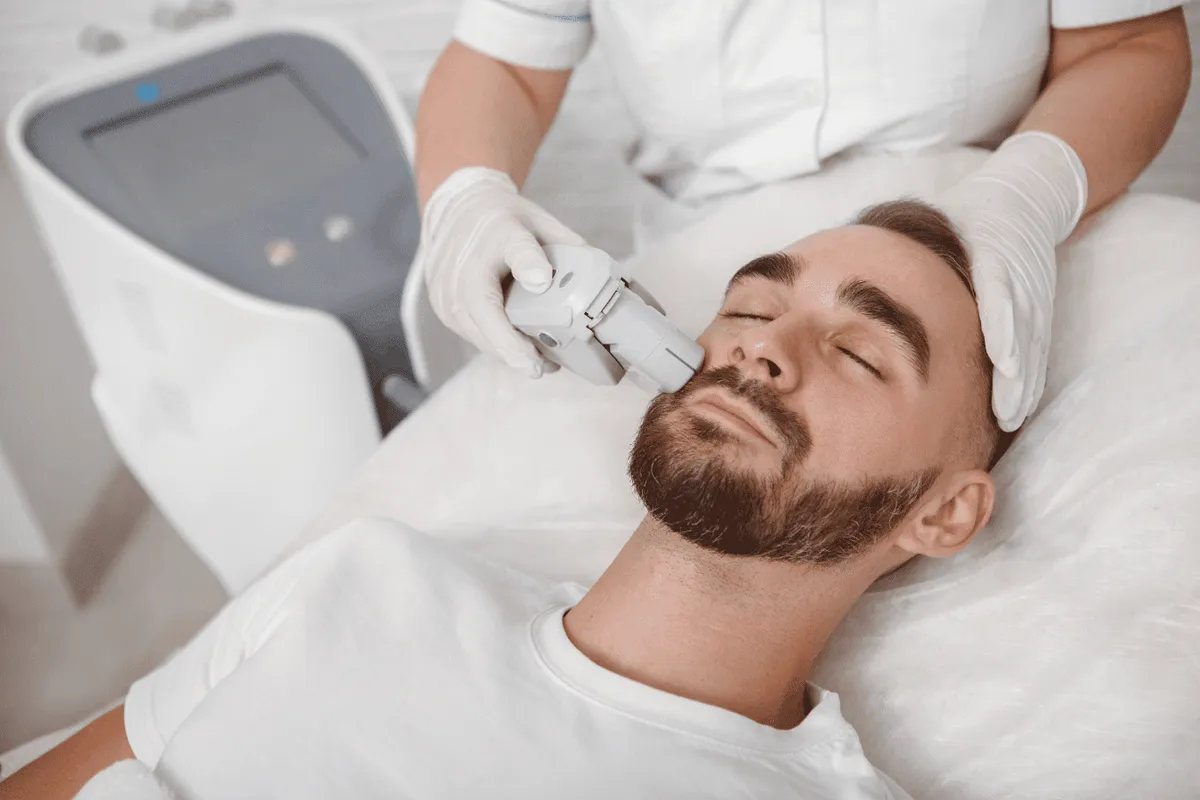
What is Moxi laser
Made by Sciton, the Moxi laser is a fractional, non-ablative laser working at a 1927 nm wavelength. Fractional means the beam treats a grid of tiny columns and leaves the skin between them untouched, so the surface heals from the edges in. Non-ablative means it heats skin without removing the top layer, the main difference from the deeper resurfacing lasers covered in laser resurfacing on Wikipedia.
The 1927 nm wavelength is absorbed by water, and Sciton lists its reach at 100 to 200 micrometers, about the thickness of one or two sheets of paper. That shallow depth is the point. Most sun spots, dullness and fine surface texture live in the upper layers of skin, so a Moxi laser can treat them without the week at home a deeper laser needs.
So what is Moxi laser best described as? A maintenance laser. Sciton markets three intensity levels, from Prevent & Refresh at the lightest setting to Transform & Renew at the strongest, and the same handpiece covers the face, neck, chest, hands, arms and legs.
Lasers in this class have regulatory history behind them. In March 2019 the FDA cleared Sciton’s JOULE 1927nm Laser System for benign pigmented lesions such as age spots, sun spots and freckles, along with actinic keratosis. That record names the JOULE system and does not mention Moxi, so ask your provider which device your center uses and what it is cleared for.
How a Moxi laser treatment works
A Moxi laser treatment starts with a consultation. At 4Ever Young, the provider looks at your skin, asks about your goals and your history, and picks the intensity before anything touches your face. Laser services are offered at select centers, so the first step is confirming that the center near you carries Moxi. You can read more on the Moxi laser treatment at 4Ever Young page.
On treatment day the skin is cleansed. Numbing cream is optional for lighter settings and more common at the stronger ones. The provider then rolls the handpiece across each area in several passes while the laser places its grid of microscopic heated columns.
Most people describe a warm, prickling feeling. In a 40-person study of a 1927 nm fractional laser, patients rated the discomfort 4.3 out of 10 on average.
Skin tone matters less with this wavelength than with many lasers. Sciton says Moxi treats all skin types year-round because the 1927 nm beam targets water rather than pigment. The research is thinner for deeper skin tones, though: the largest pigment study below included Fitzpatrick types I to IV only, and UT Southwestern has since run a small pilot in types V and VI. Your provider sets the intensity with that in mind.
The laser time itself is short. Sciton puts a typical Moxi treatment at 8 to 10 minutes, not counting numbing time, which is why it often fits into a lunch break. What happens next takes longer: the treated columns push old, pigmented cells toward the surface to shed, and the heat signals the skin to build new collagen over the following weeks. That is why a Moxi treatment is usually planned as a short series rather than a single visit.
Results by skin concern
Most Moxi laser before and after photos show change in three places: brown spots, surface texture and overall brightness. When you look at Moxi before and after pictures from any clinic, check the lighting and how many weeks passed since the last session, because pigment fades first and texture keeps improving for a month or more. The research behind those photos is real but modest, and it is worth knowing its size before you book.
Sun damage & uneven tone
Pigment from the sun is where the evidence is strongest. In a multicenter study published in the Journal of Drugs in Dermatology in 2014, 40 adults aged 30 to 80 had two treatments with a 1927 nm fractional laser from another manufacturer. Blinded physicians graded overall improvement as moderate to very significant in 82 percent of patients one month later, and in 69 percent at three months. Age spots and freckles improved by the same grade in about 68 percent at one month.
A trial at UT Southwestern used Moxi itself. Of 30 enrolled participants, 27 had two monthly treatments, and imaging counts of UV spots fell from 29.4 and 25.4 on the left and right sides of the face to 22.4 and 21.6 one month later. By three months the counts had drifted partway back, to 25.8 and 24.3.
“Moxi lifts sun damage you already have. Daily sunscreen decides how quickly it returns.”
Melasma needs a more careful promise. 4Ever Young lists it among the concerns Moxi can address, and the laser can lighten it, but the American Academy of Dermatology notes there is no single best melasma treatment and that sun protection can help fade melasma and keep it from returning. Expect a plan that pairs Moxi with sunscreen and skincare.
Fine lines & rough texture
Texture responds more slowly than pigment because collagen takes weeks to rebuild. In a 2023 study in Frontiers in Surgery, 27 adults with mild to moderate photoaging had three 1927 nm treatments a month apart. Their global photoaging score fell from 3.44 to 2.67, wrinkle measurements improved after the first month, and pores improved after the second treatment.
Deep wrinkles are a different job. A shallow laser softens fine lines and roughness, while deeper folds belong with injectables or stronger devices. If you are weighing the wider menu, compare the laser facial treatment options 4Ever Young offers.
Prejuvenation in your twenties & thirties
Prejuvenation means treating skin before visible aging sets in, and 4Ever Young describes Moxi as ideal for it. The honest version is simple: no study has followed young patients on Moxi for years to prove it delays aging. What the trials show is that it clears early sun damage and refreshes texture, which keeps small problems small.
The prevention with the best proof costs far less. In a randomized trial of 903 adults under 55, published in the Annals of Internal Medicine in 2013, people who used broad-spectrum sunscreen every day showed 24 percent less skin aging over four and a half years than people who used it only sometimes. For someone in their twenties or thirties, an occasional Moxi session works best on top of that habit, not instead of it.
Moxi laser downtime & aftercare
For most people, Moxi laser downtime is short, and Sciton describes it as little to none. Studies of 1927 nm lasers give a clearer picture: swelling and warmth faded within 24 hours, and redness cleared within a week. A few people with dry skin to begin with noticed some flaking.
Plan the first days around the sun and gentle care.
- Use a bland cleanser and moisturizer while the skin settles, and skip scrubs.
- Wear a broad-spectrum sunscreen of SPF 30 or higher every day, and stay out of tanning beds.
- Ask your provider when to restart retinoids or glycolic acid. The American Academy of Dermatology advises stopping them 2 to 4 weeks before laser treatment for scars.
- Tell your provider if you get cold sores. A preventive medicine may be prescribed before your visit.
- Book around events. Most people return to work the same day, but redness can linger for a few days at the stronger settings.
Treatment is not done on tanned or sunburned skin, so a beach week right before a session usually means rescheduling.
How to start with a Moxi laser facial
A Moxi laser facial at 4Ever Young begins with the skin consultation, where the provider checks for active breakouts, recent sun exposure, medications that affect healing and your history of cold sores. From there the plan sets the intensity level, the number of sessions and how far apart they fall.
Many patients do best with a pairing. A BBL Moxi laser plan uses BBL broadband light therapy for redness, visible vessels and brown spots, and Moxi for texture and fine lines. Both run on Sciton platforms, and 4Ever Young describes the two together on its Moxi & BBL laser facials page.
Results build across the series, and how long they last depends mostly on sun habits. For many people, a session every few months keeps tone even once the first series is complete.
Start with a skin consultation
A 4Ever Young provider checks your skin, confirms Moxi is offered near you and sets the plan in one visit.
Find a CenterMoxi FAQ
01How Much Does Moxi Laser Cost?
Moxi laser cost at 4Ever Young varies by center, the intensity level, the area treated and how many sessions your plan includes, so your provider quotes it at the consultation. Members can put the 4Ever Reserve plan, which adds $99 a month to a personal service bank, toward any service, and both membership plans include 10 to 20 percent off most services.
02Moxi vs BBL: Which Should You Choose?
In the Moxi vs BBL choice, pick by concern. BBL uses broadband light and suits redness, rosacea, visible vessels and brown spots with no downtime. Moxi is a fractional 1927 nm laser that adds texture, fine lines and pore refinement to pigment care, with redness that usually clears within a week. Many plans use both, and a 4Ever Young provider can sequence them at centers that offer both.
03How Many Sessions Do You Need?
Sciton recommends 2 to 4 Moxi sessions, and the published 1927 nm studies cited here used two or three treatments, most about a month apart. Some improvement can show after one visit. Because UV spot counts began drifting back within three months in the UT Southwestern Moxi trial, many patients add a maintenance session every few months alongside daily sunscreen.
Wondering whether Moxi, BBL or a pairing fits your skin? Book a consultation →
Featured From the Blog
 Featured · Skin
Lumecca IPL Photofacial: Brightening Pigmentation Safely
How the Lumecca IPL photofacial uses intense pulsed light to fade sun spots and uneven pigment without surgery, and how it compares with lasers and peels.
By Claritza Valle · Oct 1, 2025Read article →


Sources
- Sciton, MOXI product page – 1927 nm fractional non-ablative design, 100 to 200 micrometer depth, 8 to 10 minute treatments, 2 to 4 recommended sessions
- U.S. Food and Drug Administration, 510(k) K182173, JOULE 1927nm Laser System, 2019 – Clearance for benign pigmented lesions such as age spots, sun spots and freckles, and actinic keratosis
- Brauer JA et al., Journal of Drugs in Dermatology, 2014 – Nonablative 1927 nm fractional resurfacing for facial photopigmentation, 40 subjects
- Li X et al., Frontiers in Surgery, 2023 – Prospective study of a 1927 nm fractional laser for photoaging, recovery timeline and side effects
- ClinicalTrials.gov NCT05226104, UT Southwestern Medical Center – Fractionated 1927 nm (MOXI) laser for diffuse pigmentation, posted results
- ClinicalTrials.gov NCT05493280, UT Southwestern Medical Center – Pilot of fractionated 1927 nm (MOXI) laser for hyperpigmentation in Fitzpatrick skin types V and VI
- American Academy of Dermatology, Melasma: Diagnosis and treatment – No single best melasma treatment, sun protection can help fade melasma and prevent its return, SPF 30 or higher
- American Academy of Dermatology, 10 things to know before having laser treatment for your scar – Cold sore prevention, pausing retinoids and glycolic acid, no treatment on tanned or sunburned skin
- Hughes MC et al., Annals of Internal Medicine, 2013 – Randomized trial: daily sunscreen and 24 percent less skin aging over 4.5 years