



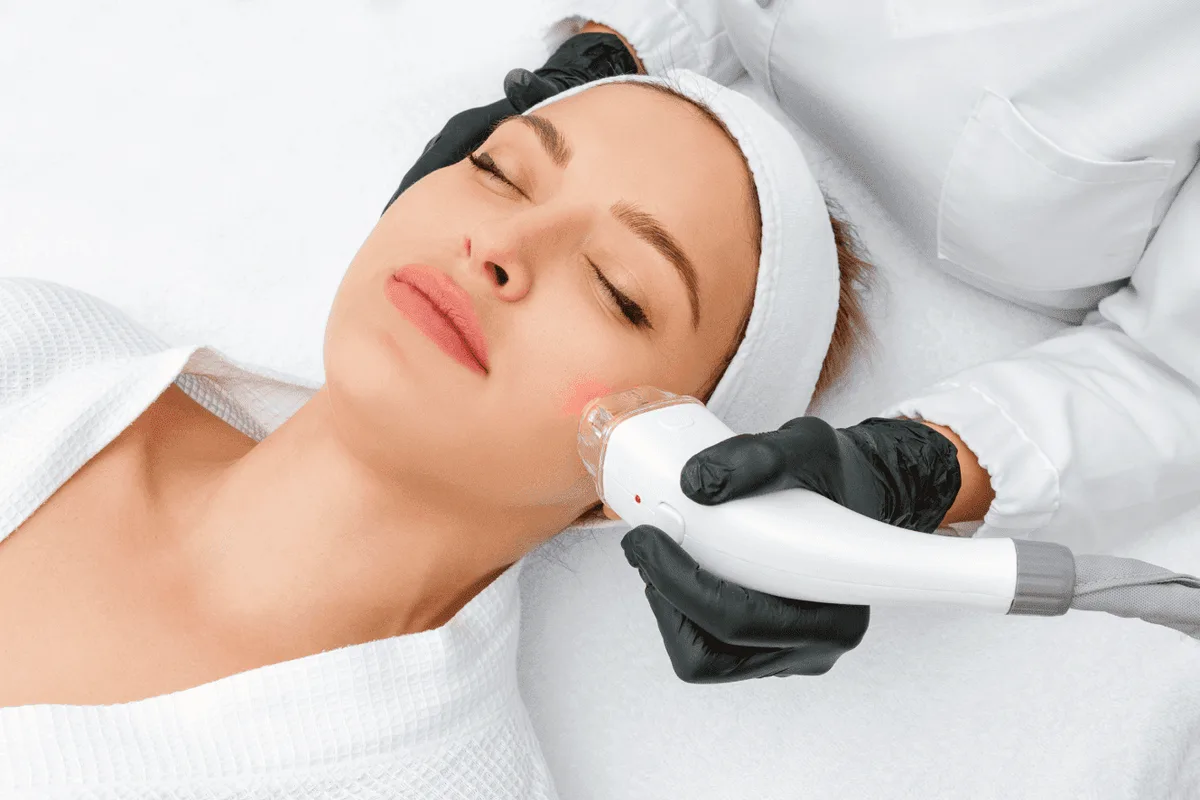
At 4Ever Young, a laser facial can mean more than a laser. Its menu mixes true lasers such as Moxi and Clear + Brilliant with light devices and radiofrequency microneedling, and each works at a different depth. These seven run from the gentlest refresh to the deepest collagen work.
BBL facial for sun damage & redness
BBL stands for broadband light. A BBL facial at 4Ever Young uses Sciton’s BBL HEROic, which pulses a wide band of wavelengths into the skin. Brown pigment and the red in small vessels absorb that light, so spots shed and visible vessels fade. 4Ever Young describes the session as fast, with no downtime.
The research is encouraging but small. In a Stanford pilot in the Journal of Investigative Dermatology, five women over 50 had three monthly BBL treatments on one forearm. Their skin improved on exam, and of 2,265 gene transcripts whose activity had shifted with age, 1,293 moved back toward the pattern seen in women under 30. For visible vessels treated with lasers or light, the American Academy of Dermatology (AAD) reports a 50 to 75 percent reduction in most patients after one to three treatments.
A BBL facial fits sun damage that shows up in two colors, freckles plus flushing, in someone who cannot take time off.
IPL laser facial for brown spots
Many people call it an IPL laser facial, though 4Ever Young’s own page notes that intense pulsed light is technically not a laser. It fires filtered flashes of many wavelengths instead of one focused beam. 4Ever Young delivers it through Lumecca, one of the Optimas Max applicators, and its Lumecca IPL photofacial guide walks through a visit.
Brown spots darken at first, then flake and fade. When the FDA cleared the Optimas MAX System in June 2025, its Lumecca Peak applicators were indicated for benign pigmented lesions, including hyperpigmentation and freckles, and for vascular lesions such as rosacea. Older evidence holds up too. In a 2000 study in Dermatologic Surgery, 49 people had four or more full-face IPL treatments three weeks apart, and more than 90 percent showed visible improvement in irregular pigment.
Searching for a laser for hyperpigmentation? Name the pigment first. Sun spots usually respond well. Melasma is harder, and according to the AAD, a few studies found that adding a laser or light treatment improves results for patients already using medicated skin care and sun protection.
Moxi laser facial for early pigment & texture
A Moxi laser treatment uses a gentle 1927 nm fractional laser that heats a grid of tiny columns in the upper skin and leaves the surface intact. Numbing cream is optional, and you may notice a slight prickling sensation. As a Moxi laser facial, it targets light spots, dullness, enlarged pores and fine lines, and 4Ever Young calls it ideal for prevention-minded patients and for maintenance between stronger treatments.
In a 2014 multicenter study of a different 1927 nm laser, blinded physicians rated two treatments as producing moderate to very significant improvement in 82 percent of 40 adults at one month. A UT Southwestern trial of Moxi itself gave 27 people two monthly treatments. UV spot counts fell from 29.4 to 22.4 on one side of the face, then drifted partway back by month three, which is why daily sunscreen matters as much as the laser.
Moxi & BBL together for tone & texture
BBL reaches the brown and the red. Moxi resurfaces the top layer, where roughness and fine lines sit. 4Ever Young presents the two side by side on its Moxi & BBL laser facials page, both on Sciton platforms.
“BBL treats the color of sun damage. Moxi treats its texture.”
The pairing suits a face that shows redness, scattered spots and rough skin at once, a common pattern after decades outdoors. Your provider sets the order and spacing. Studies of the combination itself are scarce, so the case rests on each device’s own evidence.
Clear + Brilliant for pores & dullness
Clear + Brilliant, often searched as Clear and Brilliant, is a non-ablative fractional laser that creates thousands of microscopic treatment zones. 4Ever Young aims it at dull skin, uneven texture and fine lines, and calls it a good first laser.
Its newer Touch version, cleared by the FDA in December 2022 for general skin resurfacing, pairs a 1440 nm handpiece with a 1927 nm one. In a trial sponsored by the maker, 28 adults had full-face treatments with both. Three months later, investigators scored improvement in signs such as pore size and texture at an average of 2.81 on a 0 to 4 scale, where 3 means 51 to 75 percent better.
Recovery is brief. A 2025 review in the Journal of Cosmetic Dermatology found that studies of the two handpieces used four sessions two to six weeks apart, and that redness and swelling settled on their own. Ask which version your center uses.
Optimas Max for full-face resurfacing
Optimas Max is a platform, not a single treatment. 4Ever Young suggests it for adults about 30 to 65 with several signs of aging at once. Its June 2025 FDA clearance lists the applicators:
- Lumecca IPL for pigment and vascular lesions
- Morpheus8 RF microneedling for soft tissue coagulation and contraction
- VasculazeMAX for vascular lesions such as leg veins
- Diolaze for hair removal
Many people search for laser skin tightening when this is the plan they want. On Optimas Max, the firming comes from radiofrequency heat delivered through microneedles, not laser light. By the AAD’s count, non-invasive laser skin tightening may take three to five treatments, with results appearing two to six months after the last.
RF microneedling with Morpheus8 for firmness & scars
RF microneedling sends radiofrequency heat through fine needles to a set depth, and the skin responds by building collagen. Morpheus8 deep skin rejuvenation at 4Ever Young targets loose skin on the face, neck and jawline, crepey skin and acne scars, with depth adjusted for each area.
Acne scars have the clearest data, though from a different RF microneedling device. In a 2014 study in the Journal of Cutaneous and Aesthetic Surgery, 31 patients with skin types III to V had four sessions six weeks apart, and 80.6 percent improved by two grades on a standard scar scale. If you have been looking for a laser for acne scars, the AAD adds that radiofrequency with microneedling can leave scars less noticeable than either alone.
Its label is narrow. FDA clearance for the Morpheus8 applicators covers dermatologic procedures that need coagulation or contraction of soft tissue, and limits energy above 62 mJ per pin to skin types I to IV. It does not name acne scars or wrinkles, so ask how your planned use fits it. In October 2025 the FDA also warned about reported burns, scarring and nerve damage with aesthetic RF microneedling, and advised choosing a licensed provider with training and experience in RF microneedling.
Laser facials compared by skin concern
Every laser facial here treats more than one thing, but each has a lane. This wider field is called photorejuvenation on Wikipedia, and here are the seven sorted by the concern each handles best.
- BBL: broadband light for brown spots and redness, studied as three monthly sessions.
- IPL (Lumecca): pulsed light for sun spots and freckles, four or more sessions in a 2000 study of an earlier IPL device.
- Moxi: a 1927 nm laser for early spots and dullness, two monthly sessions in the Moxi trial.
- Moxi & BBL: laser plus light for color and texture together, spaced per patient.
- Clear + Brilliant: 1440 and 1927 nm laser for pores and dullness, four sessions in the combined-handpiece studies.
- Optimas Max: IPL and radiofrequency on one platform for several concerns at once.
- Morpheus8: RF microneedling for laxity and acne scars, four sessions six weeks apart in a scar study of a similar device.
A word on laser facial before and after photos. They mean something only when lighting and angle match and the caption says how long after the last session the picture was taken. Pigment changes show within weeks, while collagen keeps building for months. The AAD notes that scar results can take months to appear.
How to choose a laser facial treatment
Start with the concern that bothers you most, then decide how much downtime you can accept. A laser facial treatment for redness is a different choice from one for acne scars. As a rough guide, BBL or IPL handle color, Moxi or Clear + Brilliant handle surface texture, and Morpheus8 handles laxity and scars.
Skin tone matters too. Some devices limit their higher settings to lighter skin types, and the FDA notes that some microneedling devices were not studied in darker skin. Bring a full medication list, since the FDA flags blood thinners and recent isotretinoin before microneedling.
Then check availability. If you searched BBL facial treatment near me, laser services vary by 4Ever Young location, so ask which devices your center carries. 4Ever Young keeps a full laser facial treatment menu online.
Start with a skin consultation
A 4Ever Young provider checks your skin and history, confirms which devices your center offers and builds the plan in one visit.
Find a CenterLaser facial FAQ
01Is RF microneedling a laser?
No. According to the FDA, RF microneedling uses radiofrequency, a type of electrical energy, delivered through tiny needles that create small points of heat in and under the skin. 4Ever Young lists Morpheus8 with its laser facials because the goals overlap: smoother texture, firmer skin and softer scars. The FDA calls RF microneedling a medical procedure that belongs with a licensed, trained provider.
02How many laser facial sessions will you need?
Most people need a series. The studies behind this list used two Moxi-type treatments, three monthly BBL sessions, four Clear + Brilliant sessions, four RF microneedling sessions six weeks apart and four or more IPL sessions. 4Ever Young notes visible IPL improvement after one to three sessions. Sun spots can return, so maintenance visits and daily sunscreen help hold the results.
03What should you avoid before a laser facial?
Avoid tanning and sunburn first. The AAD says a provider cannot treat tanned or sunburned skin with a laser. It also advises stopping retinoid and glycolic acid products for 2 to 4 weeks, quitting smoking for at least 2 weeks and asking about vitamin E, aspirin and other supplements that can slow healing. If you get cold sores, ask about preventive medicine.
Not sure which device fits your skin? Book a consultation →
Featured From the Blog
 Featured · Skin
IPL Photofacial Vs. Traditional Laser: Pros & Cons
How IPL photofacials and true lasers differ in the light they use, which one suits redness, sun spots and signs of aging, and how they compare on results and downtime.
Sep 16, 2025Read article →
Sources
- U.S. Food and Drug Administration, 510(k) K251632, Optimas MAX System, 2025 – Clearance date and applicators: Lumecca Peak for pigmented and vascular lesions, Morpheus8, VasculazeMAX, Diolaze XL MAX
- U.S. Food and Drug Administration, 510(k) K231790, InMode System with the Morpheus8 Applicators, 2023 – Indication: dermatologic procedures needing coagulation or contraction of soft tissue, energy above 62 mJ per pin limited to skin types I to IV
- U.S. Food and Drug Administration, 510(k) K223647, CLEAR + BRILLIANT TOUCH Laser System, 2022 – 1440 nm and 1927 nm handpieces, cleared for coagulation of soft tissue and general skin resurfacing
- U.S. Food and Drug Administration, Potential Risks with Certain Uses of RF Microneedling, 2025 – How RF microneedling works, reported complications, medical procedure, choose a trained licensed provider
- U.S. Food and Drug Administration, Microneedling Devices – Who may not be suited to microneedling: cold sores, tanning, blood thinners, isotretinoin, darker skin types
- Chang AL et al., Journal of Investigative Dermatology, 2013 – Broadband light pilot: three monthly treatments, clinical improvement and 1,293 of 2,265 genes shifted toward young skin
- Bitter PH, Dermatologic Surgery, 2000 – 49 subjects, four or more full-face IPL treatments at three-week intervals, more than 90 percent improved
- Brauer JA et al., Journal of Drugs in Dermatology, 2014 – Nonablative 1927 nm fractional laser for facial pigment, 40 subjects, 82 and 69 percent improvement
- ClinicalTrials.gov NCT05226104, UT Southwestern Medical Center – MOXI 1927 nm laser, two monthly treatments, UV spot counts at baseline, one and three months
- ClinicalTrials.gov NCT05027282, Bausch Health – CLEAR + BRILLIANT TOUCH 1440 nm and 1927 nm, 28 participants, quartile improvement scores
- Geronemus RG et al., Journal of Cosmetic Dermatology, 2025 – Safety review of the 1440 and 1927 nm diode laser system: session counts, redness and peeling timelines
- Chandrashekar BS et al., Journal of Cutaneous and Aesthetic Surgery, 2014 – Microneedling fractional radiofrequency for acne scars, 31 patients, four sessions six weeks apart
- American Academy of Dermatology, Acne scars: Consultation and treatment – Radiofrequency microneedling versus either treatment alone, laser resurfacing for scars
- American Academy of Dermatology, Rosacea treatment: Lasers and lights – 50 to 75 percent reduction in visible vessels after one to three treatments, three to four weeks apart
- American Academy of Dermatology, Many ways to firm sagging skin – Laser skin tightening sessions and timeline, ablative resurfacing downtime
- American Academy of Dermatology, 10 things to know before having laser treatment for your scar – No treatment on tanned skin, pausing retinoids and glycolic acid, smoking, supplements, cold sores, results take months
- American Academy of Dermatology, Melasma: Diagnosis and treatment – Laser and light treatments added to medication and sun protection