



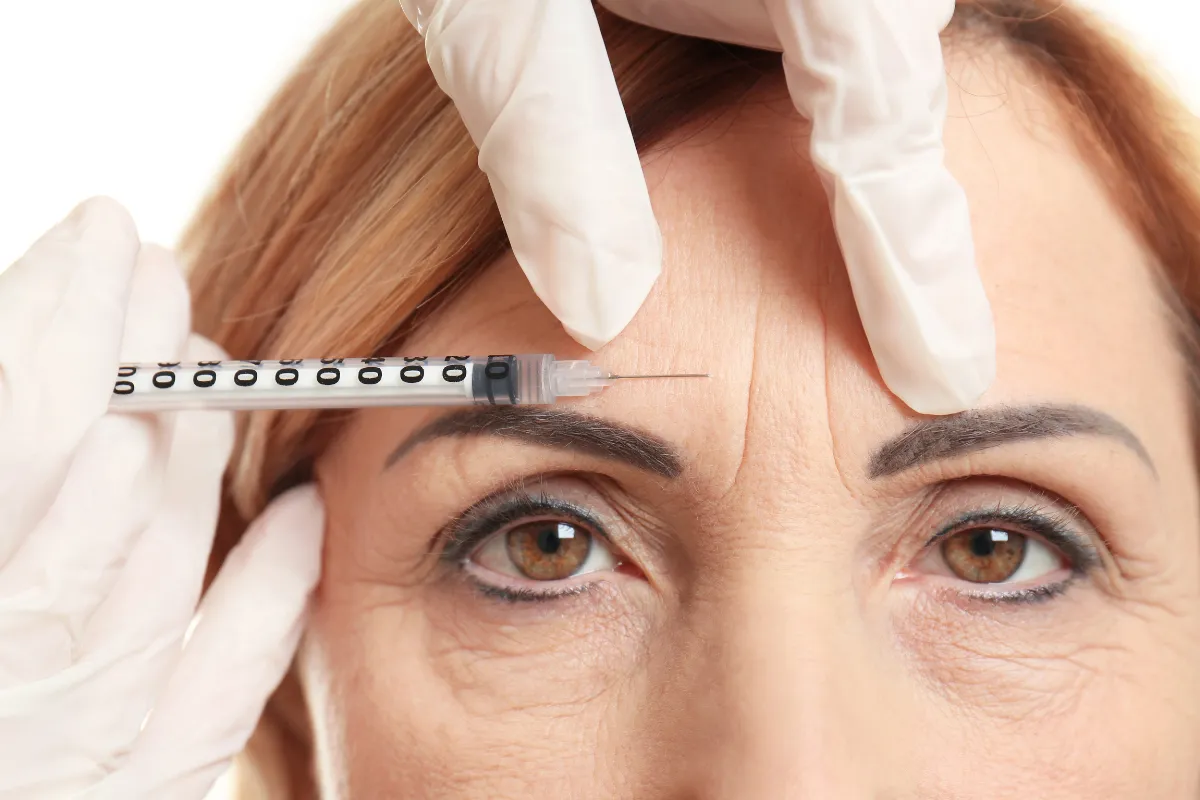
Dysport and Xeomin relax the same expression muscles with the same type of protein, botulinum toxin type A. What separates them sits around the edges: the areas each one is approved for, how quickly the change shows, how many units a visit takes and what else is in the vial. 4Ever Young providers inject both, so the choice can follow your lines and your calendar instead of a brand habit.
Dysport vs Xeomin verdict for busy schedules
If your calendar decides it, the Dysport vs Xeomin question usually comes down to scope. Are you treating only the frown lines between your brows, or the whole upper face? Xeomin is the only one of the two with FDA approval for frown lines, forehead lines and crow’s feet treated together, an approval the FDA granted in July 2024. For someone who wants all three areas handled on-label in a single appointment, that settles it.
Dysport earns its place when the frown lines are the main concern. In a 2024 head-to-head trial, Dysport patients scored higher on frown line improvement at the later checkpoints, a hint that its effect holds well toward the end of a cycle. That trial was small. Treat it as a signal.
Neither product buys fewer visits by rule, because both labels set the same three-month minimum between sessions. A provider offering Dysport treatment at 4Ever Young or Xeomin sets your interval from how quickly your muscles return.
Xeomin vs Dysport at a glance
Every clinical row below comes from the current FDA prescribing information for each product or from two peer-reviewed head-to-head trials, checked October 21, 2026. If you have read Xeomin vs Dysport pages before, this is the version with the sources attached.
| Category | Dysport | Xeomin |
|---|---|---|
| Active ingredient | AbobotulinumtoxinA | IncobotulinumtoxinA |
| Accessory proteins in the vial | Yes | ✓ None, toxin only |
| First FDA cosmetic approval | April 29, 2009, frown lines | 2011, frown lines |
| FDA-approved facial areas | Frown lines in adults under 65 | ✓ Frown lines, forehead lines, crow’s feet in adults |
| Labeled dose for frown lines | 50 Units across 5 sites | 20 Units across 5 sites |
| Labeled dose for the full upper face | Not approved | ✓ 64 Units across 3 areas |
| Median onset in women, 2013 trial | 5.32 days | ✓ 3.02 days |
| Median duration in women, 2013 trial | 140 days | ✓ 146 days |
| Frown line improvement at week 12, 2024 trial | ✓ 90% | 48% |
| Re-treatment floor | Every 3 months | Every 3 months |
| Neutralizing antibodies in frown line trials | None in 1,554 tested | None in 464 tested |
| Most common side effect in frown line trials | Cold symptoms, 10% | Headache, 5% |
| Unopened vial storage | Refrigerated | Room temperature |
| Offered at 4Ever Young | ✓ Yes | ✓ Yes |
| Membership pricing | ✓ Discounted for members | Member savings on most services |
Read the trial rows with care. The 2013 study gave 63 Units of Dysport, more than the labeled 50, and the 2024 study analyzed 43 patients. Each points in a direction. Neither settles the question.
How Dysport & Xeomin compare side by side
Both products block the nerve signal that tells a muscle to contract, which is why the lines on top of that muscle soften. They are measured in their own units, made in different ways and approved for different areas, and those three facts drive most of what follows.
What is Xeomin & why it is a purer toxin
So what is Xeomin? It is incobotulinumtoxinA, made by Merz, first approved in the United States in 2010 and approved for frown lines in 2011. The IncobotulinumtoxinA drug profile covers the chemistry. “Purer” refers to manufacturing. Xeomin is refined down to the 150 kDa neurotoxin itself, without the accessory proteins that travel with the toxin in Dysport and Botox Cosmetic.
One visible effect of that formula is storage: unopened Xeomin vials can sit at room temperature, while Dysport stays refrigerated. That matters more to the clinic than to you.
Does purer mean better results? No trial has shown that. The argument for a protein-free toxin is about antibodies, which the FAQ below takes up. If you are also weighing a newer toxin, the Jeuveau vs Xeomin comparison walks through that pairing.
Onset of visible results
The usual answer to how long does Dysport take to work is under a week, which is what 4Ever Young’s Dysport page tells patients. Xeomin follows a similar arc. The 4Ever Young Xeomin page describes first results at 3 to 4 days and the full effect by 7 to 10 days.
A randomized trial that timed all three leading toxins found Xeomin fastest. In 2013, 180 adults received a single frown line treatment, and median onset in women came at 3.02 days for Xeomin against 5.32 days for Dysport, with men a little later on every product. The Dysport dose ran above label and Merz paid for editorial help on the paper, so weigh the gap accordingly.
Time between touch-ups
Here the labels agree. Neither product should be repeated more often than every three months, and the Dysport label reports frown line improvement for up to four months.
For how long does Xeomin last in real use, the 2013 trial gives the best numbers: the median effect in women lasted 146 days for Xeomin and 140 days for Dysport, close to four and a half months, while men came in near 120 days on both. The 2024 trial leaned the other way. At week 12, an independent evaluator rated 90 percent of Dysport patients improved at maximum frown, compared with 48 percent on Xeomin.
Two trials, two leanings. Plan on three to four months from either product, with your muscle strength and dose deciding where in that window you land.
Lines each toxin treats best
Approval is where the two separate most clearly. Xeomin is FDA approved for moderate to severe frown lines, horizontal forehead lines and crow’s feet in adults, with forehead lines treated alongside the frown lines and all three areas at once capped at 64 Units. Dysport is approved for moderate to severe frown lines in adults younger than 65. Providers do use Dysport on the forehead and around the eyes, and that use is off-label.
- Frown lines between the brows: approved for both. In the FDA trials, 48 to 60 percent of Xeomin patients and 52 to 60 percent of Dysport patients reached the strict two-grade success mark at day 30.
- Forehead lines: on-label for Xeomin when treated with the frown lines, off-label for Dysport.
- Crow’s feet: on-label for Xeomin, off-label for Dysport.
- A broad forehead: Dysport has a reputation for spreading a little farther from the needle, which some injectors use to cover a wide area.
Xeomin side effects in its frown line trials were mostly minor, with headache the most common at 5 percent, and brow droop showed up in under 1 percent of upper face patients. In the Dysport frown line trials, 10 percent of patients reported cold symptoms, and eyelid droop and eyelid swelling each reached 2 percent.
Units & cost per area
Units do not transfer between products, a warning printed on both labels. A frown line treatment uses 50 Units of Dysport or 20 Units of Xeomin, each spread over five injection points. Xeomin’s full upper face dose tops out at 64 Units: 20 for the frown lines, 20 for the forehead and 24 for crow’s feet.
That gap shapes Dysport cost and Xeomin cost. Dysport is usually priced lower per unit and needs more of them. Xeomin’s labeled frown line dose matches the 20 Units used for Botox Cosmetic, so the price per area tends to land closer than per-unit numbers suggest.
Pricing varies by center and is quoted at your consultation, once the provider knows how many units your muscles need. The 4Ever Reserve membership carries the best rates on tox treatments, and both membership tiers take 10 to 20 percent off products and most services.
One consult, two toxins on the menu
A 4Ever Young provider maps your lines, then chooses Dysport or Xeomin and the dose in a single visit. Centers nationwide.
Book a ConsultationWho should choose Dysport or Xeomin
Xeomin injections fit best when your list goes beyond the frown lines, or when you would rather use a formula without accessory proteins.
- Forehead lines and crow’s feet sit on your list along with the 11s, and you want all three treated on-label in one visit.
- You are 65 or older, which falls outside the Dysport label.
- You have a cow’s milk protein allergy. Dysport may contain trace amounts, and its label lists that allergy as a contraindication.
- You stopped responding to another toxin and your provider suspects antibodies. Switching is reasonable to discuss, though the evidence in cosmetic patients is thin.
Dysport fits best when the frown lines are the main event and you are under 65.
- The deep vertical lines between your brows bother you most.
- Dysport has worked well for you before and held through the end of your cycle.
- Your injector plans to use its wider reach across a broad forehead, understanding that forehead treatment with Dysport is off-label.
- You want the member pricing 4Ever Young names on its membership page: discounted Botox and Dysport.
Both come through Xeomin injections at 4Ever Young and the Dysport menu, given by the same medical team, so trying one never rules out the other.
Bottom line on Botox vs Dysport vs Xeomin
Most people asking about Botox vs Dysport vs Xeomin would do well with any of the three. Between the two compared here, Xeomin brings the broader on-label upper face approval and a protein-free formula. Dysport brings a frown line record dating to its 2009 FDA approval and a strong late showing in one recent trial. Botox Cosmetic, the third option, carries its own list of approved areas.
Whichever you pick, plan on three to four months between visits. Membership savings on treatments make that rhythm easier to keep, and one consultation at a 4Ever Young center settles the toxin, the units and the injection points.
Dysport vs Xeomin questions patients ask
01How Long Does Xeomin Take to Work?
How long does Xeomin take to work? Most people see softening in 3 to 4 days and the full effect by 7 to 10 days, according to 4Ever Young’s Xeomin page. In a 2013 trial of 180 adults, median onset in women was 3.02 days for Xeomin compared with 5.32 days for Dysport. The FDA trials judged final results at day 30.
02How Long Does Dysport Last?
How long does Dysport last? The FDA label reports frown line improvement for up to four months, with re-treatment no sooner than every three months. In the 2013 head-to-head trial, the median effect lasted about 140 days in women and 116 days in men. Your dose, muscle strength and treatment history move that number.
03Is Xeomin Better for Toxin Resistance?
Possibly, though the proof is limited. Xeomin carries no accessory proteins, which a 2025 JMIR Dermatology review links to a lower chance of antibodies. Resistance is rare at cosmetic doses either way: no neutralizing antibodies appeared in the 464 Xeomin or 1,554 Dysport frown line patients tested. In small cosmetic reports, switching after resistance gave mixed results.
Not sure which toxin fits your lines? Book a consultation at a center near you →
Featured From the Blog
 Featured · Injectables
Jeuveau vs. Dysport: Which Wrinkle Treatment Is Right for You?
Who makes Jeuveau and Dysport, how far each one spreads, how long results usually hold and how to tell which suits your frown lines.
By Claritza Valle · Jun 17, 2025Read article →

Sources
- Xeomin (incobotulinumtoxinA) Prescribing Information, revised June 2026 – upper facial line indications, doses, adverse reactions, immunogenicity, storage
- Dysport (abobotulinumtoxinA) Prescribing Information, DailyMed, revised September 2023 – frown line indication for adults under 65, 50 Unit dose, duration, adverse reactions, cow’s milk protein
- Rappl T et al., Clinical, Cosmetic and Investigational Dermatology, 2013 – onset and duration of incobotulinumtoxinA, onabotulinumtoxinA and abobotulinumtoxinA in 180 adults
- Lee JH et al., Archives of Aesthetic Plastic Surgery, 2024 – multicenter head-to-head of abobotulinumtoxinA and incobotulinumtoxinA for frown lines
- Kroumpouzos G, Silikovich F, JMIR Dermatology, 2025 – nonresponse to botulinum toxin in aesthetics, complexing proteins and switching
- FDA supplement approval letter, Xeomin BLA 125360/S-099, July 5, 2024 – FDA approval of Xeomin for simultaneous treatment of forehead lines, frown lines and crow’s feet